Early Skin Cancer Detection & Dermoscopy
Learn why early skin cancer detection saves lives and how expert dermoscopic assessment at Hinchley Medical provides accurate, early diagnosis and peace of mind.
Patient information
Skin cancer is the most common cancer in the UK. When detected early, it is highly treatable — often with simple, minimally invasive procedures. Expert dermoscopic assessment helps spot suspicious lesions at the earliest stage so you get rapid, accurate answers and personalised care.
Book an expert skin check
Updated: 7 December 2025
Skin cancer is now the most common cancer in the UK, with cases continuing to rise each year. While this can sound worrying, there’s an important piece of good news: when detected early, skin cancer is highly treatable — often with simple, minimally invasive procedures.
Why Early Detection Matters
Quicker, simpler treatment
Catching a melanoma or non-melanoma skin cancer early usually means smaller procedures, less scarring, and better long-term outcomes.
Dramatically improved survival rates
For melanoma — the most serious type of skin cancer — early-stage detection can result in over 95% survival.
Prevents spread
Skin cancers can grow or spread to other parts of the body if left untreated. Identifying changes early allows your clinician to intervene before this happens.
What Makes Dermoscopy So Important?
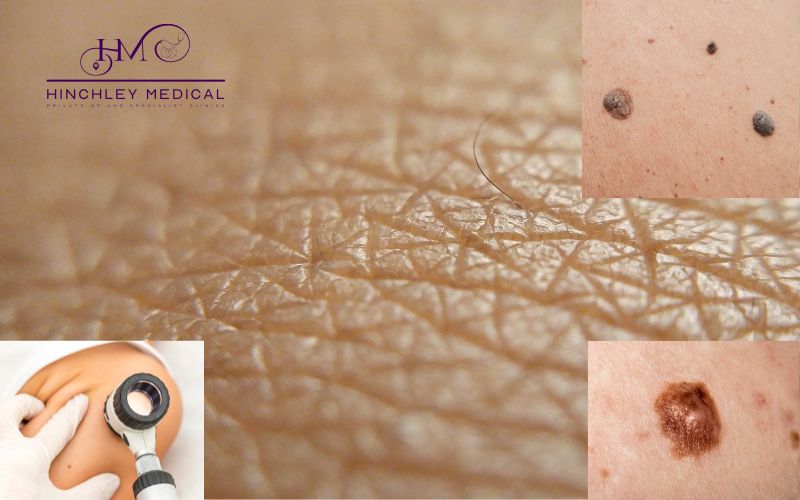
Dermoscopy (or dermatoscopy) is a non-invasive technique using a magnifying, polarised light device to reveal structures in the skin that aren’t visible to the naked eye. It is the gold standard for assessing moles, sun damage, and suspicious lesions, and it significantly increases diagnostic accuracy.
Benefits of dermoscopic assessment at Hinchley Medical
- Higher accuracy in detecting early melanoma and other skin cancers
- Improved differentiation between benign and suspicious lesions
- Reduced unnecessary biopsies
- Documentation and digital monitoring of lesions over time
- Fast reassurance for lesions that are harmless
Our specialist skin clinicians are trained in advanced dermoscopy, allowing the earliest possible detection of subtle abnormalities.
What to Look For: Common Skin Cancer Warning Signs
ABCDE changes in moles
- Asymmetry
- Border irregularity
- Colour variation
- Diameter over 6mm
- Evolving in size, shape, or symptoms
Other concerning symptoms
- New lesions that don’t heal
- Scaly or crusted patches
- Bleeding or itching
- Pearly, pink, or translucent bumps
- Rapidly growing lumps
If you notice any change, even a small one, it’s best to get it checked promptly.
Your Skin Check at Hinchley Medical
During your appointment, our clinicians carry out:
- Full medical and skin history
- Targeted or full-body dermoscopic assessment
- High-resolution imaging where appropriate
- Immediate feedback on concerning or benign lesions
- Referral pathways for rapid biopsy or dermatology if needed
Our aim is to provide fast, expert reassurance — or swift treatment when necessary.
Who Should Get a Skin Check?
You should consider regular skin checks if you have:
- A history of sunburn or high UV exposure
- Fair skin, freckles, or numerous moles
- A family history of melanoma or skin cancer
- Past or current use of sunbeds
- A mole or skin lesion that has recently changed
- A desire for peace of mind
We recommend annual full-body skin checks, or more frequent reviews for higher-risk individuals.
Quick facts
Skin cancer caught early is almost always curable. Dermoscopy is one of the most powerful tools for detecting the earliest signs.
Prioritise your skin health today
Book an expert dermoscopic skin check with our specialist clinicians.